
Popis
Tessera is a developer library for plugin authors who register abilities via wp_register_ability() and want snapshot capture, audit logging, approval workflows, and one-click rollback for every invocation across REST, MCP, internal PHP, and WP-CLI without building it themselves.
Declare what state your ability touches; Tessera handles the safety wrapper.
What you get out of the box
- Pre + post snapshots. Every safety-enabled invocation captures declared state before the callback and (on success) after, so the audit log can show a real diff.
- Audit log. One row per invocation with ability name, caller (REST/MCP/CLI/internal), user, args, result, status, duration, pre/post hashes, and parent_invocation_id for nested calls.
- One-click rollback. Restore captured state from post_meta, options, taxonomy term assignments, user roles + caps. File contents support tiered drift detection (mtime / mtime_size / critical_hash / full_hash) plus opt-in real byte-level rollback via
full_contentstrategy. - Drift check on rollback. Live state is hashed and compared to the snapshot’s post-state before restoring; if they differ the rollback returns an error unless forced.
- Concurrency lock. Capture + execute is serialised per surface set via a MySQL advisory lock so two simultaneous invocations do not capture each other’s mid-states.
- Encrypted redaction. Scrub secrets out of args, results, and snapshots. Stores redacted values as AES-256-GCM envelopes so rollback can still restore them.
- Approval queue. When
safety.requires_approvalis set, the wrapper blocks execution and returns a 202 pending response. A human approves or rejects via wp-admin, WP-CLI, or REST. Multi-stage sequential or parallel approval chains are supported. - Multisite support. Each subsite gets its own set of
wp_<N>_abilityguard_*tables, with auto-install onwp_initialize_siteand auto-drop onwpmu_drop_tables. - Retention. Daily WP-Cron prunes old log rows (defaults: 30 days normal, 180 days destructive) and orphaned snapshots.
Surfaces
- PHP API with
wp_register_ability( $name, [ ..., 'safety' => [...] ] )and helpersabilityguard_rollback,abilityguard_snapshot_meta,abilityguard_snapshot_options. - REST:
/abilityguard/v1/log,/log/<id>,/log/export,/rollback/<id>,/rollback/bulk,/approval,/approval/<id>/approve,/approval/<id>/reject,/approval/bulk,/approval/export,/retention,/retention/prune,/health. - WP-CLI:
wp abilityguard log list/show,wp abilityguard rollback <id>,wp abilityguard approval list/approve/reject <id>,wp abilityguard prune. - wp-admin: Tools > Tessera. Hybrid timeline + command-palette search, snapshot drawer, JSON-highlighted Input/Result tabs, invocation chain navigation, and real rollback against the captured snapshot.
Example
wp_register_ability( 'my-plugin/update-product-price', array(
    'label'               => 'Update product price',
    'description'         => 'Updates the price on a WooCommerce product.',
    'category'            => 'woocommerce',
    'input_schema'        => array( /* ... */ ),
    'permission_callback' => fn() => current_user_can( 'manage_woocommerce' ),
    'execute_callback'    => fn( $args ) => update_post_meta( $args['product_id'], '_price', $args['price'] ),
    'safety' => array(
        'destructive'       => true,
        'requires_approval' => false,
        'snapshot'          => fn( $input ) => array(
            'post_meta' => array( $input['product_id'] => array( '_price', '_regular_price' ) ),
            'options'   => array( 'woocommerce_last_price_change' ),
        ),
    ),
) );
Documentation
Full plugin-author documentation lives at the GitHub repo: https://github.com/ibrahimhajjaj/abilityguard
Source Code
The full source for Tessera, including the unminified React source for the admin app, lives on GitHub: https://github.com/ibrahimhajjaj/abilityguard
- The admin bundle
assets/admin.jsis compiled fromassets/admin.jsx(React + JSX, no preprocessor magic beyond JSX). - The bundler is esbuild, configured in
scripts/build.mjs. - To rebuild the admin bundle from a fresh checkout, run
npm installonce, thennpm run buildwheneverassets/admin.jsxchanges. This regeneratesassets/admin.jsin place. - The release zip published to the WordPress.org directory is produced by
scripts/build-release.sh, which excludes development artifacts (tests, examples, build configs) but keeps everything required for the plugin to run.
Obrázky
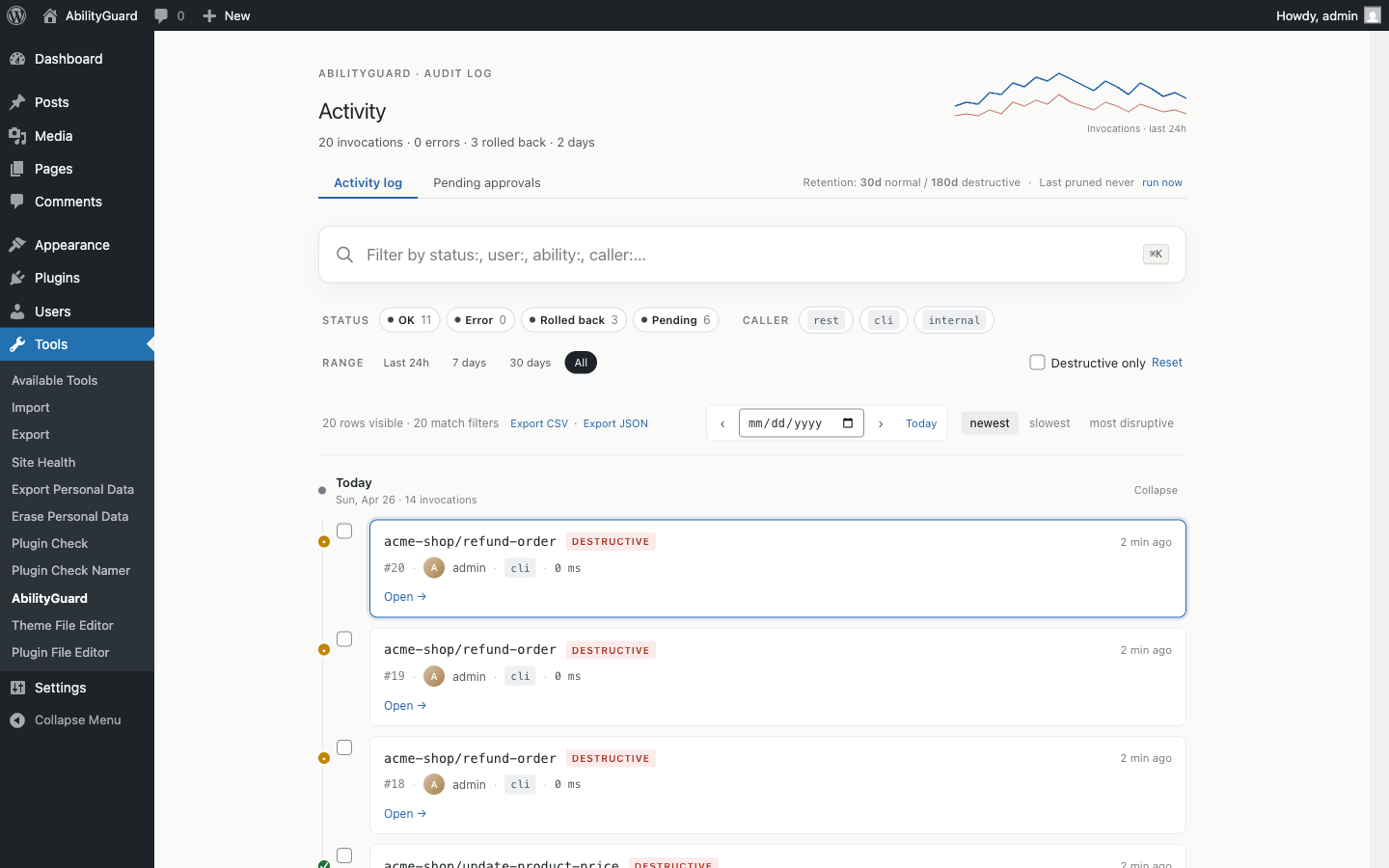
Invocation timeline. Every ability call across REST, MCP, internal PHP, and WP-CLI, with caller attribution and per-row status. 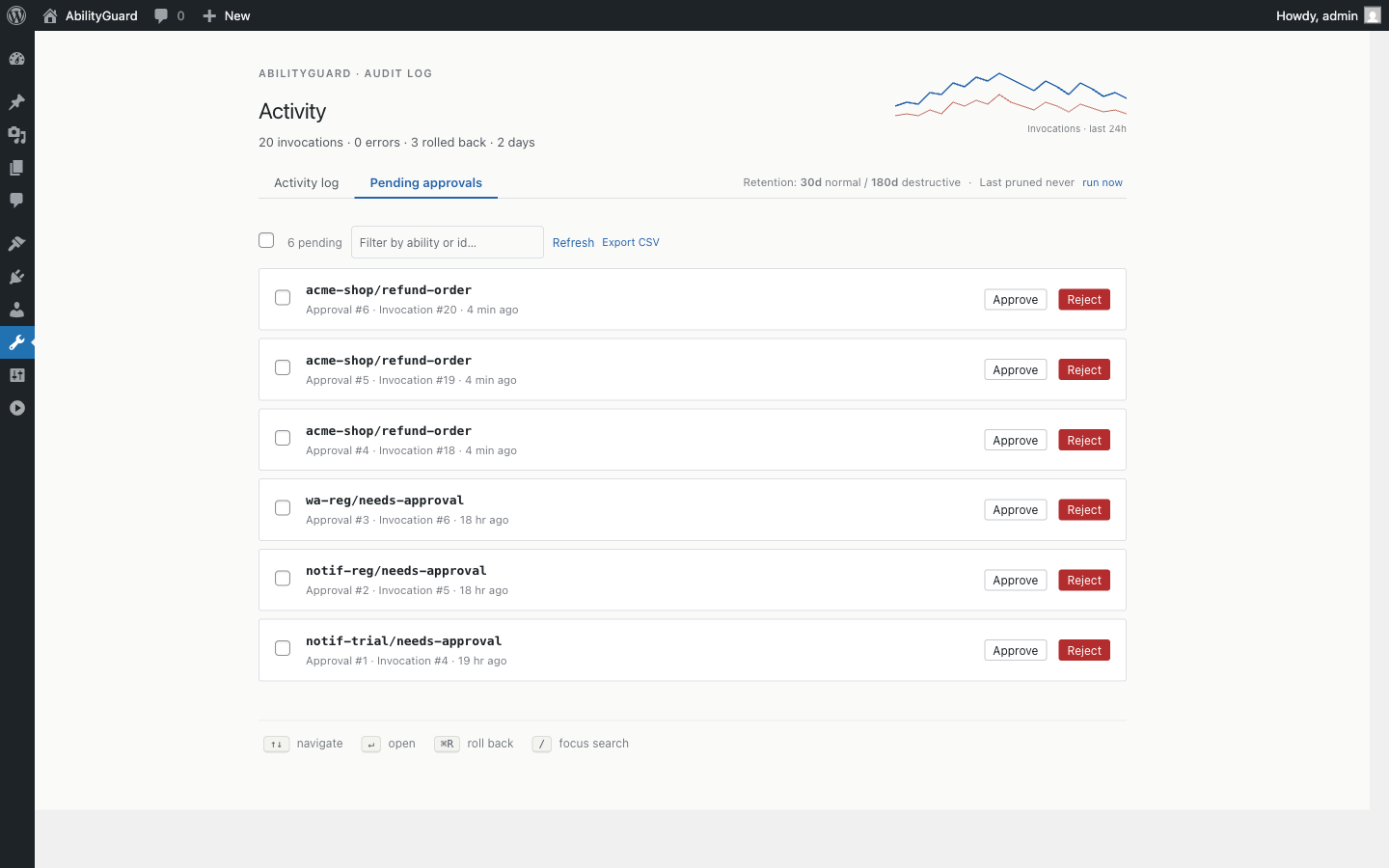
Approvals queue. Pending requests waiting on a human, with the requesting context and a one-click approve or reject. 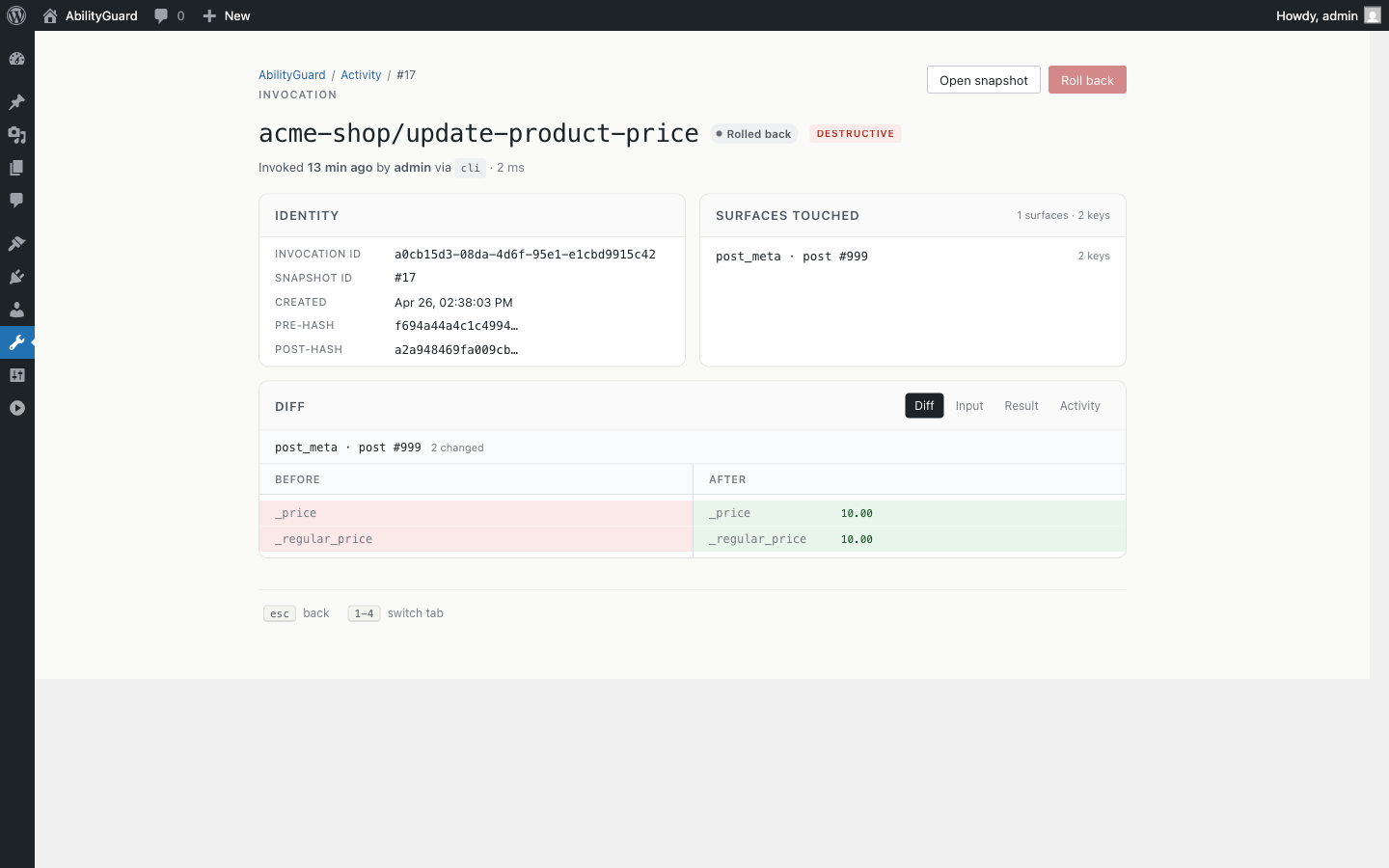
Invocation detail after a one-click rollback restored the captured pre-state. 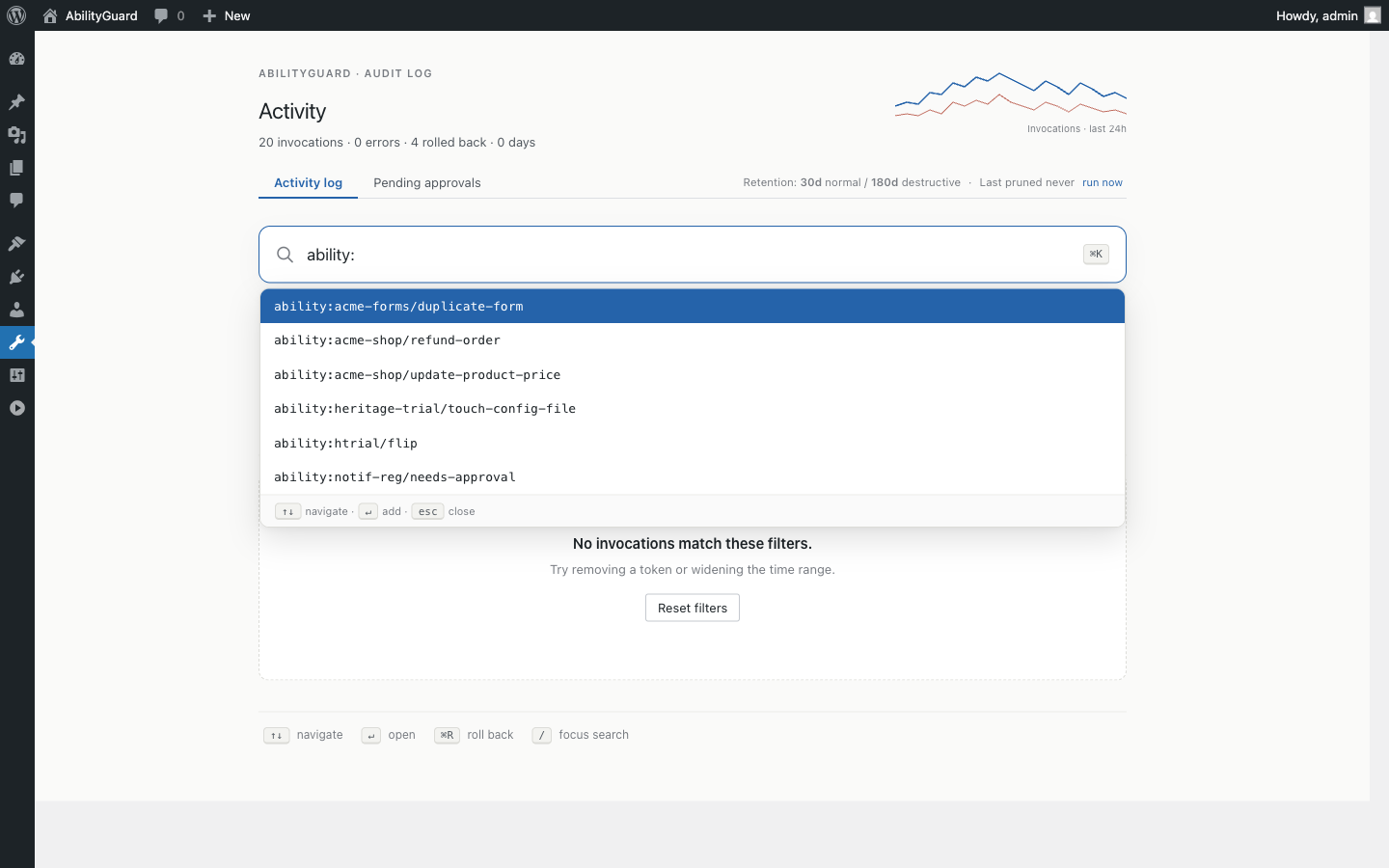
Search-as-you-type in the log: ability name, caller, status. 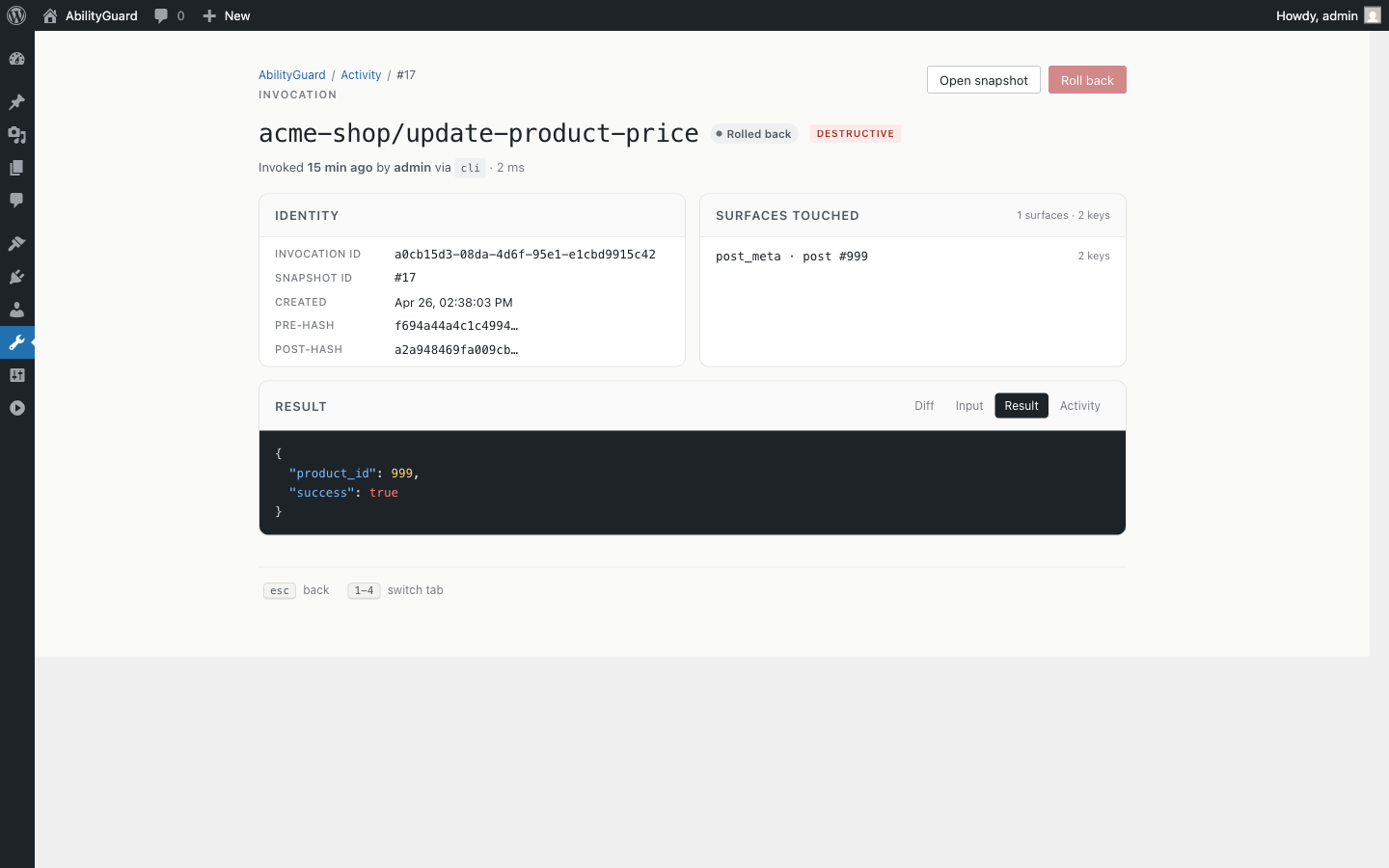
Invocation detail, result tab, with redacted secret values restored on display when the encryption key is present. 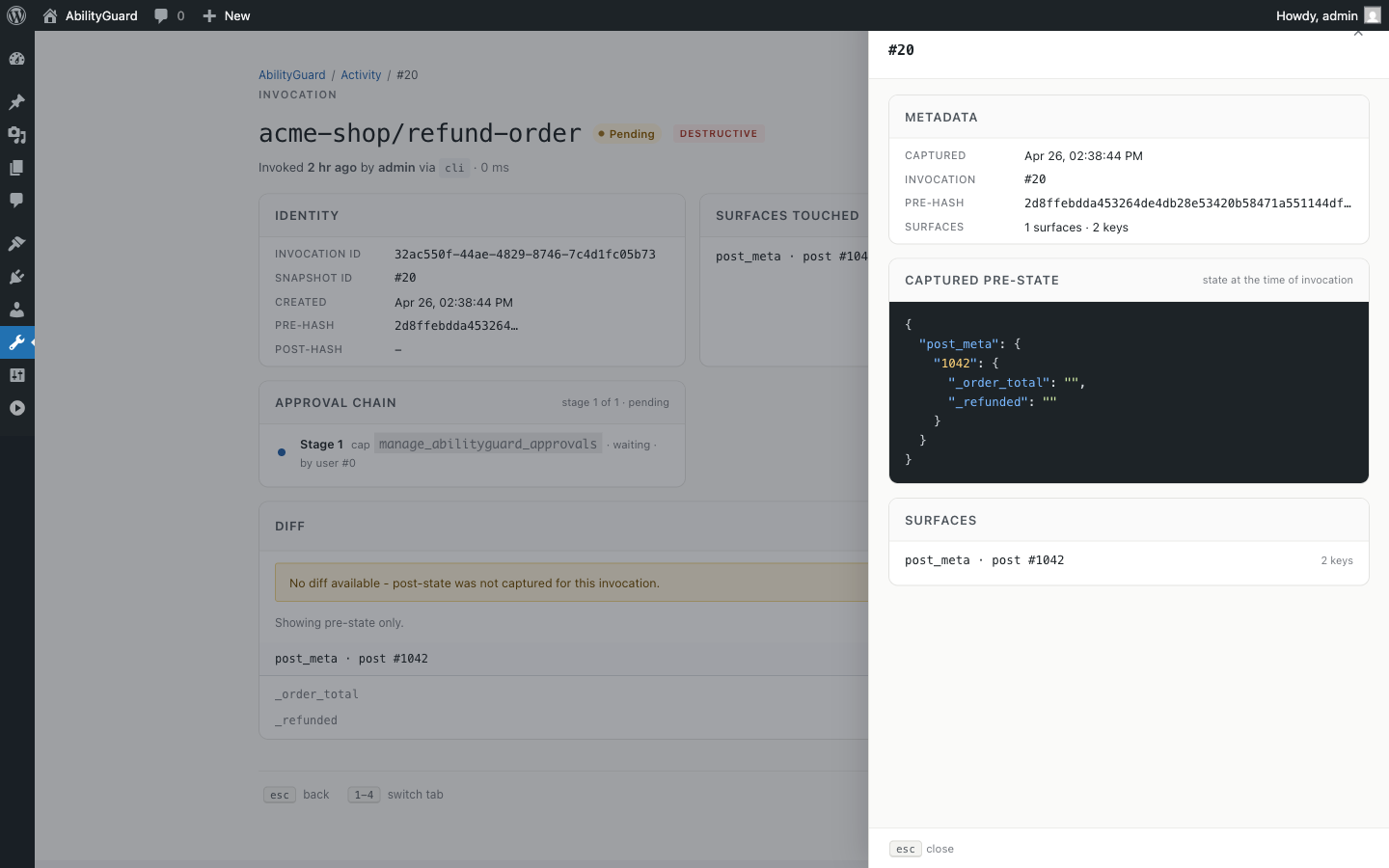
Snapshot drawer showing the captured pre-state and post-state for a destructive invocation. 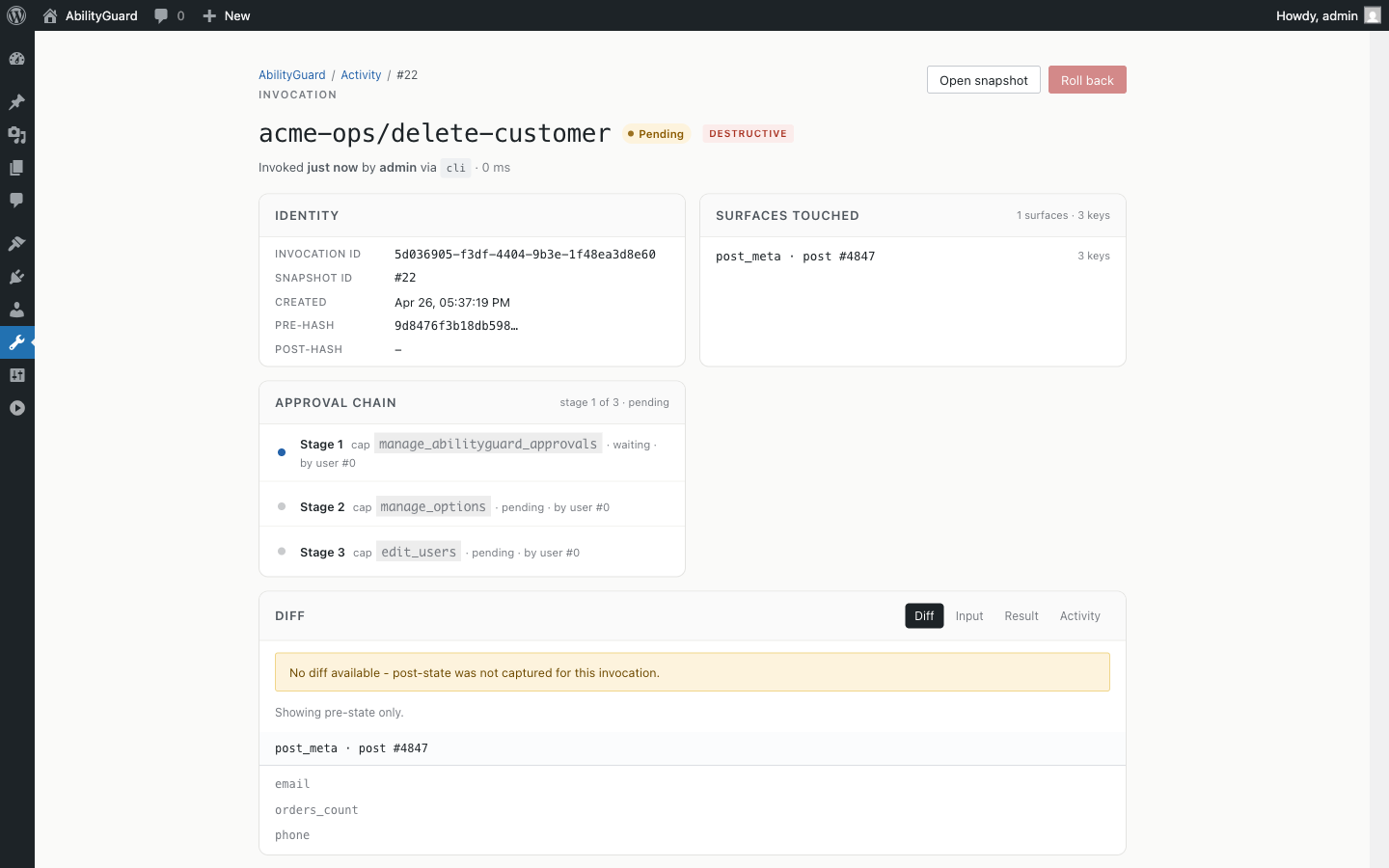
Multi-stage approval chain with per-stage capability and role routing.
Inštalácia
- Upload the
abilityguard-mcpfolder to/wp-content/plugins/. - Activate the plugin through the Plugins menu in WordPress (or network-activate on multisite).
- Visit Tools > Tessera to view the audit log.
- In your own plugin, register abilities via
wp_register_ability()with asafetyconfig.
Requires WordPress 6.9 or later (for the Abilities API) and PHP 8.1 or later.
Časté otázky
-
Does this work without other plugins?
-
It will activate without registered abilities, but it only does work when other plugins register abilities with a
safetyconfig viawp_register_ability(). -
What state surfaces are supported for snapshots?
-
post_meta, options, taxonomy term assignments, user roles + caps, and files (with five tiered strategies from mtime to full content rollback).
-
Does it support multisite?
-
Yes. Each subsite gets its own set of
wp_<N>_abilityguard_*tables. New subsites are auto-installed viawp_initialize_site; deleted subsites have their tables dropped viawpmu_drop_tables. -
How does it handle concurrent invocations?
-
Per-surface MySQL advisory locks (GET_LOCK) serialise capture + execute so simultaneous invocations do not capture each other’s mid-states.
-
Are secrets encrypted in the log?
-
Yes. Redaction uses AES-256-GCM envelopes so rollback can still restore the original value when the encryption key is intact.
Recenzie
Pre tento plugin nie sú žiadne recenzie.
Prispievatelia a vývojári
“Tessera for the Abilities API” je softvér s otvoreným zdrojovým kódom. Do tohto pluginu prispeli nasledujúci ľudia.
Prispievatelia
Preložiť „Tessera for the Abilities API“ do vašho jazyka.
Máte záujem o vývoj?
Prehľadávajte zdrojový kód, preskúmajte SVN repozitár, alebo sa prihláste na odber vývojárskeho logu cez RSS.
Zoznam zmien
1.3.5
- Release zip no longer ships
composer/installersand its unused installer adapters. Cuts the published zip from 909K to 824K and 206 files to 98.
1.3.4
- Release zip now ships
vendor/autoload.phpso the plugin actually boots on a fresh install. (1.3.3 zip was missing the autoloader and fatal’d on activation.)
1.3.3
- Display name changed to „Tessera for the Abilities API“ to clearly distinguish this plugin from any future official safety library. Slug, text domain, and internal namespace are unchanged.
error_log()calls in the rate-limiter and concurrency lock are now gated behindWP_DEBUG, so production hosts no longer accumulate noise from fail-open paths.readme.txtgains a Source Code section documenting the GitHub repository, the esbuild-based build pipeline, and thenpm run buildcommand used to regenerateassets/admin.js.
1.3.2
- Slug renamed to
abilityguard-mcpfor the WordPress.org directory. - Snapshot file blobs now stored under
wp-uploads/abilityguard-mcp/instead ofwp-content/abilityguard-staging/. - Admin page CSS folded into the existing enqueued bundle; no more inline
<script>/<style>echoes. $_SERVER['REMOTE_ADDR']is unslashed and sanitized before being hashed for IP-keyed rate-limit principals.
1.3.1
- Skipped (broken release-workflow build).
1.3.0
- Sliding-window-counter rate limiter with multi-policy support (burst + sustained), pluggable storage (Redis / object cache / transient), and IETF draft RateLimit headers.
- Dry-run mode: per-call
safety.dry_runpreviews a destructive ability, persists the diff, auto-rolls-back, and surfaces details via/dry-run/<id>REST endpoint andabilityguard_get_dry_run_result()helper. Result returns untouched so it validates againstoutput_schema. - Approval queue gains per-stage role routing (
approval_roles) and separation-of-duties enforcement across the chain. - Per-status retention via
abilityguard_retention_days_by_status. /statsREST endpoint and admin dashboard widget (counts, p50/p95, top abilities).- Wrapper split into observability listeners on
wp_before_execute_ability/wp_after_execute_abilityplus an enforcement seam (abilityguard_pre_execute_decisionfilter) for plugin extensions. - Reads
meta.annotations.destructivedirectly from core (WP 6.9 surface), no parallel safety metadata. - Requires WP 6.9; pre-6.9 fallback path removed.
1.2.0
- Parallel multi-stage approval chains with optional per-stage user pinning.
/healthREST endpoint and a pending-approvals badge in the admin bar.- WP-CLI:
log show --diff,approval show,prune --all-sites. - JSONL export option for audit log.
- Real byte-level file rollback via
safety.snapshot.files.strategy = 'full_content'(AES-256-GCM, content-addressed sidecar staging dir, atomic writes, 256 KB per-file cap). - Full multisite support with auto-install on subsite creation and auto-drop on subsite deletion.
- Sequential and parallel multi-stage approval chains.
1.1.0
- Multi-stage approval queues.
- Invocation correlation via
parent_invocation_idand an admin-side invocation chain navigator. log_metatable for extensible per-row metadata.
1.0.0
- Initial public release.
- Snapshot, audit, rollback, and approval middleware for the WordPress Abilities API.
- Five collectors: post_meta, options, taxonomy, user_role, files.
- REST + WP-CLI + wp-admin surfaces.
- Encrypted redaction, payload caps, retention pruning.